Mount Batur Jeep or Trek: Which Sunrise Tour Should You Book?
In this guide
- What a jeep tour actually does
- What the sunrise trek actually does
- Does the jeep reach the summit?
- How hard is the climb, really?
- Which one starts earlier?
- Jeep against trek, side by side
- Which suits children and older walkers?
- Which is better when the summit is in cloud?
- Can you do both on one morning?
- What each costs beyond the fare
- Who should book neither
- Frequently asked
What a jeep tour actually does
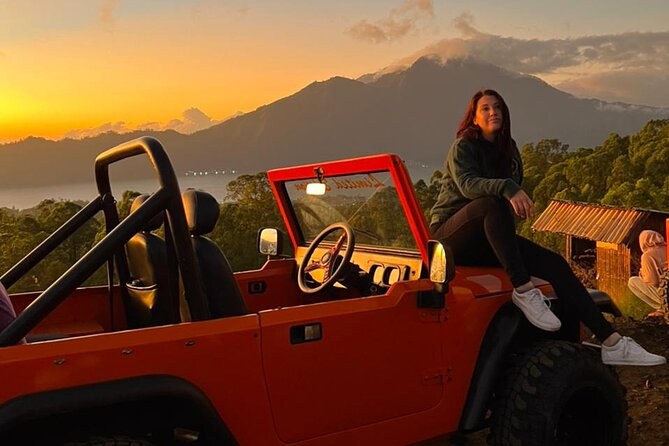
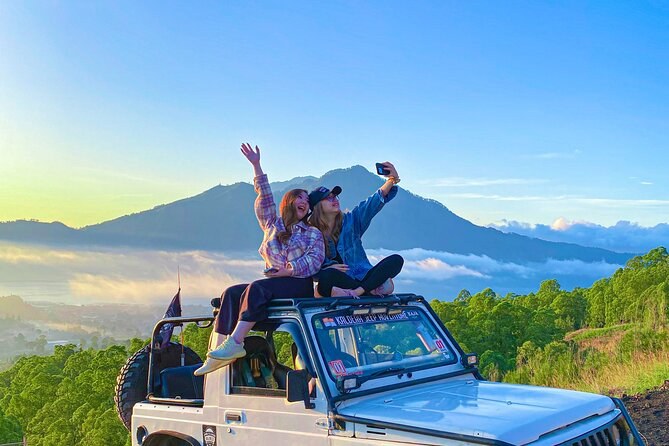
A jeep departure collects you from your hotel in the dark and drives you up the western flank of the volcano in a classic Suzuki 4WD. It parks facing east at a viewpoint one operator puts at about 1,360 metres, breakfast and a hot drink are served on the roof, and you watch the sun come up over Abang and Agung with the caldera below you.
Once the light is properly up, the jeep drops off the viewpoint and runs out across the black lava field left by the 1963 eruption — coarse black rock and sand with almost nothing growing on it six decades later. That field is the part of the mountain nothing else reaches, and it is the real reason a jeep industry exists here at all.
You walk nowhere. Seven departures here run this way, from $20, and most of them offer add-ons afterwards: the hot springs, a Kintamani cafe with the caldera below the terrace, an ATV circuit or a rafting run.
What the sunrise trek actually does
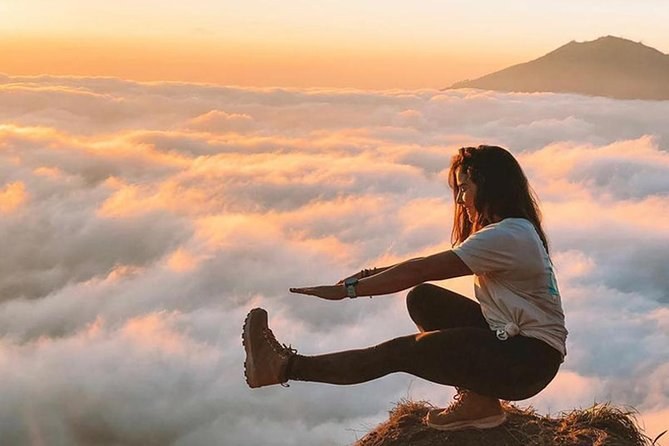
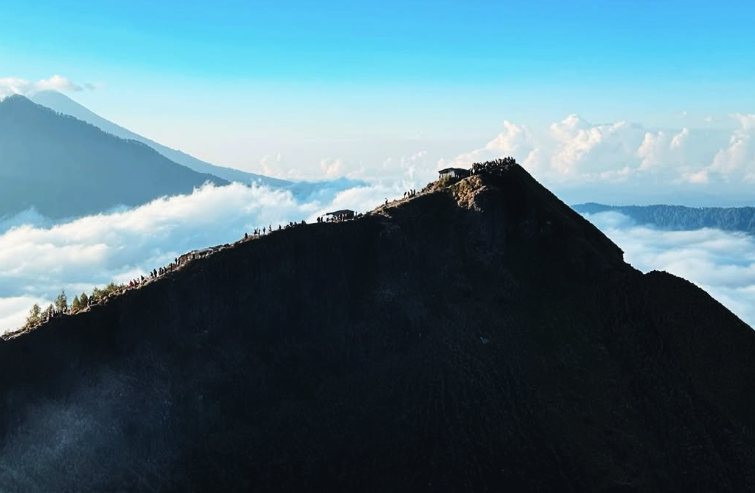
A trekking departure collects you earlier, drops you at a base camp above Songan at about a quarter past three, and hands you a head torch and a walking pole. You then climb roughly 700 metres of loose volcanic scoria in the dark with a licensed guide, reaching the crater rim in about two hours.
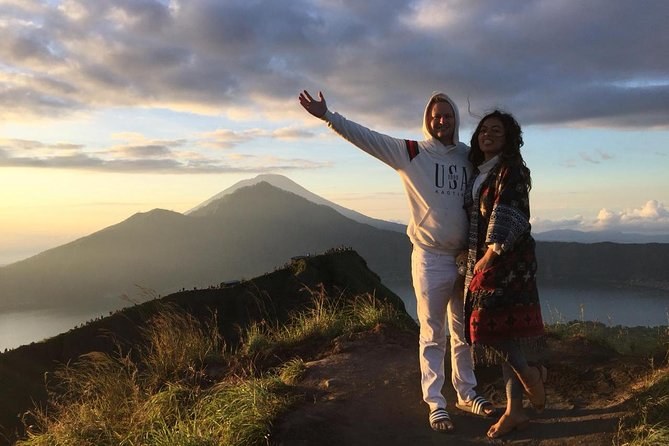
The summit carries a painted marker reading BATUR 1717 M, and the path continues along the rim of the active crater past steam vents that leak warm gas through the rock. Guides bury eggs in those vents and dig them out for breakfast, served with a banana sandwich and a hot chocolate while the sky changes.
The descent takes about ninety minutes and most travellers find it the harder half, because the gravel moves under you in daylight. Seven departures here climb, from $25.
Does the jeep reach the 1,717-metre summit?
No, and this is the single most common misunderstanding about Mount Batur. One operator states its viewpoint height as roughly 1,360 metres. Another says plainly on its own listing that the jeep cannot reach the actual summit at 1,717 metres because there is no road access to the top.
Every photograph you have seen of a jeep silhouetted against the sunrise was taken more than 350 metres below the peak. That does not make it a worse photograph — the light is the same light — but if the marker in the black sand is the reason you are coming, no vehicle will take you to it.
One listing sells a combination grade. It drives you up and then walks you to the top, which is the honest middle answer for a group that cannot agree. It is a tour grade chosen at checkout, not something arranged at the base camp.
How hard is the climb, really?
Harder than the height suggests and easier than the fear suggests. Nothing on the trail is technical: no scrambling, no exposure, no equipment beyond the pole and torch handed to you. What makes it work is the surface, which is volcanic scoria — loose gravel that gives back about half of every step you take uphill, and slides under you coming down.
Every trekking listing asks for moderate fitness rather than experience. In practice, if you can walk uphill for two hours with stops, you will finish. Walkers in their mid-seventies do it regularly. People who set off fast in the first twenty minutes are the ones who struggle.
Two other things matter more than fitness. The first is the hour: you are walking at half past three in the morning, which your body will have opinions about. The second is the cold at the top, where you stop moving at 1,717 metres in the wind and wait for the sun.
Which one starts earlier?
The trek, usually by about an hour. Trekking departures need you at the base camp by roughly 03:15 to start walking at 03:30 and reach the rim before six. Jeep departures only need you at the viewpoint by about half past five, so the pickup can be later from the same address.
Both are governed by where you sleep more than by the format. From Ubud, an hour away, treks collect between 02:00 and 03:30. From Seminyak or Kuta, two hours away, the same trek collects between 01:15 and 02:30. Uluwatu, Jimbaran and Nusa Dua go first at 01:00.
The published windows by area are set out on getting there, and they are worth reading before you book rather than after.
Jeep against trek, side by side
| Jeep tour | Sunrise trek | |
|---|---|---|
| Height reached | About 1,360 m viewpoint | 1,717 m summit |
| Time on your feet | Almost none | About 3.5 hours |
| Typical pickup | 02:00 – 03:30 | 01:00 – 03:00 |
| Fares here | $20 – $41 | $25 – $53 |
| Minimum age on the listings | From 2 | 5 to 18 |
| Reaches the summit marker | No | Yes |
| Reaches the crater rim path | No | Yes |
| Reaches the 1963 lava field | Yes, about an hour | On some grades |
| Breakfast | On the jeep roof | On the crater rim |
| Excludes back and heart conditions | On some listings | On nearly all |
| Departures listed here | Seven | Seven |
Figures taken from the operators’ own listings. Fares are starting prices per person and move with grade and pickup zone.
Compare every Mount Batur tour
Which suits children, and which suits older walkers?
The jeep, on both counts, though not for the same reason. Minimum ages on the jeep listings start at two, with infants travelling on a lap; the trekking listings set theirs between five and eighteen, and one sets it at eighteen outright. A ten-year-old who walks regularly will manage the climb; a ten-year-old who does not will have a miserable two hours in the dark.
For older travellers the question is knees rather than lungs. Walkers in their seventies finish the climb regularly and say so, but the descent on loose gravel is where the risk sits. A jeep morning removes that entirely and still delivers the sunrise, the caldera and the lava field.
Mixed parties have a third option worth knowing: several operators sell both formats on the same booking, so one half of a group can climb while the other rides, and everybody meets at the bottom.
Which is better when the summit is in cloud?
Neither, honestly — but the jeep loses less. Cloud on this mountain sits in a band rather than filling the sky, and the viewpoint at about 1,360 metres is sometimes below it while the rim at 1,717 is inside it. Just as often it works the other way and the walkers climb out of the cloud into clear air while the jeeps sit in grey.
What is certain is that neither refunds you for it. A departure that runs into fog is a departure that ran. Twelve of the listings here rebook or refund if the operator cancels for weather, which is a different situation entirely.
The fix is the calendar, not the format. The dry season from April to October gives you materially better odds of a clear dawn than November to March — the timing guide works through the months and what each one does to your chances.
Can you do both on one morning?
Yes, on one listing. A jeep operator sells a grade combining the 4WD ride with a hike to the summit, which is the answer for anyone who wants the marker but not the whole 700 metres. It is chosen at checkout and priced there.
The other way to do both is over two mornings, which almost nobody does and is not a bad idea if the first one clouds over. Fares here start at $20 and free cancellation runs to 24 hours, so a second attempt is cheaper than most people assume.
What each format costs beyond the fare
Very little, and the same for both. Tips are excluded from every departure listed here and are the one cost worth carrying cash for. The Kintamani area charge on the caldera road applies to self-drivers between 08:00 and 17:00, not to tour vehicles arriving before dawn, and the Bali tourist levy of IDR 150,000 is a provincial charge for your whole stay rather than anything to do with the mountain.
Where the formats do differ is in what they tempt you to add. Jeep listings carry more add-on grades — hot springs, ATV, rafting, a cafe stop — and each one moves the price. The prices guide takes each fare apart and shows what the difference actually buys.
Who should book neither
If your reason for coming is the caldera rather than the volcano, you do not need a departure at all. The viewpoints along the Penelokan road look straight across the bowl at the cone and the lake, the geopark museum sits on the same stretch, and the hot springs are open to anyone who drives down to the shore.
That morning costs you the gate charge and a car, and it is a genuinely good few hours — the guide to doing it without a tour sets out exactly what is open to you and what is not. It is also the honest answer for anyone who does not want to get up at one in the morning, which is a completely reasonable position.
Frequently asked
Is the jeep tour cheaper than the trek?
Usually, but not always. Jeep fares here start at $20 and treks at $25, and the most expensive departure of all is a private trek with hot springs at $53. Private transport and add-ons move the price far more than the format does.
Do both formats include hotel pickup?
Every departure listed includes a transfer from its stated zones. Several exclude or surcharge Uluwatu, Amed, Lovina, Tabanan, Karangasem and Singaraja, and the exclusions are named on each card.
Can I change from the trek to the jeep on the morning?
No. The grade is fixed when you book, because it decides which vehicle and which guide are waiting for you. If you are unsure, book a listing that carries both grades and choose at checkout.
Which gives better photographs?
The trek reaches the marker, the crater rim and the steam vents, so it has more subjects. The jeep gives you a vehicle in the foreground and a driver who will take the photograph for you, which nearly every review mentions.
Is the jeep suitable if I have back problems?
Check the individual listing. The track out to the lava field is rough by design, and several jeep listings exclude travellers with back problems for exactly that reason.
Every guided way up the volcano is compared on price, pickup zone and what the fare covers: mount batur jeep tour. The full list sits on Mount Batur Tours.
Tours that fit this guide
One of each format, plus the listing that sells both on a single booking.